Petr Cech and the skull fracture that changed football, 20 years on
Petr Cech's fractured skull in October 2006 changed the course of his career and influenced football's approach to player safety. Two decades later, his remarkable comeback remains a powerful story of resilience.

Petr Cech has no memory of the incident that nearly cost him his life.
The last thing he can recall of Chelsea’s visit to the Madejski Stadium to face Reading 20 years ago, on October 14, 2006, is switching ends after the pre-match coin toss.
Video footage fills in the blank of the 17 seconds that immediately followed the home side’s kick-off: Steve Sidwell passed to Nicky Shorey, who moved the ball back to goalkeeper Marcus Hahnemann. His long kick flew just over the head of Khalid Boulahrouz and bounced beyond Paulo Ferreira as it skidded into Chelsea’s penalty area.
Stephen Hunt, eager to impress on his Premier League debut, refused to give up on the loose ball as Cech slid out to claim it. At the last moment, he withdrew his right foot from the path of the oncoming Chelsea goalkeeper, which bent his knee into a point. It was this pointed knee which caught Cech hard on the left side of his head as Hunt slid past him.
No one present seemed to realise the gravity of what had happened.
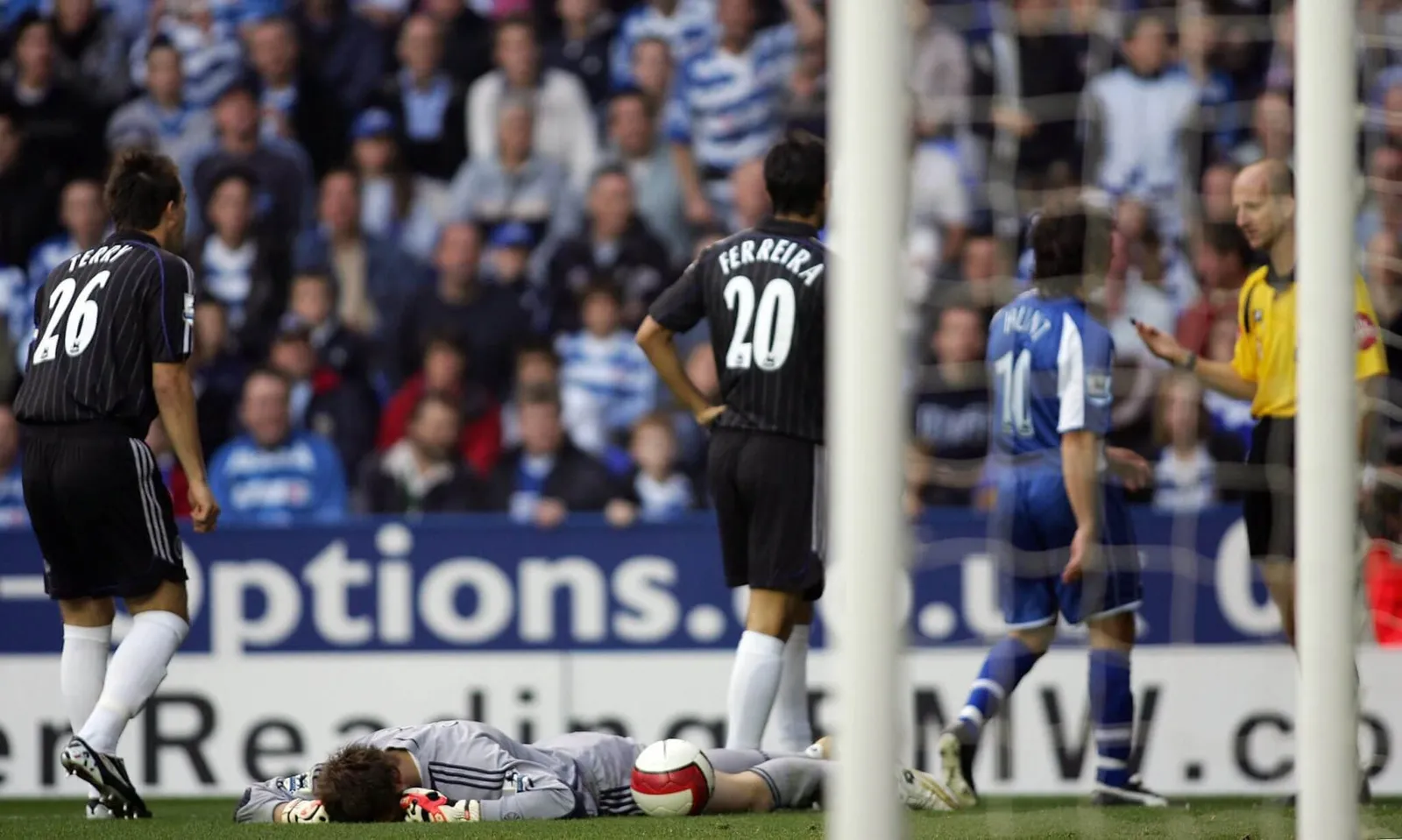
Hunt got up and jogged downfield, apparently oblivious, before jogging back over and giving Cech an apologetic tap as the goalkeeper lay sprawled on the floor. A couple of Chelsea players stood and watched their team-mate receive treatment with concerned expressions while others spoke to referee Mike Riley who, after quickly beckoning Chelsea’s medics onto the pitch and talking to Hunt, betrayed no unusual sense of urgency about the situation.
ADRIAN DENNIS/AFP via Getty Images
The only reaction that hinted something was seriously wrong was that of Cech himself. Chelsea’s goalkeeper never lost consciousness, but immediately rolled flat onto his back as the club’s medics ran over to him. He then tried to sit back up, crawled off the pitch on his hands and knees, then sank onto his back again. At one point he waved his gloved right hand in front of his face as if to signal a problem with his vision.
Four and a half minutes elapsed between the collision and Cech’s exit from the pitch on a stretcher. At no stage were paramedics present, and an ambulance had to be called to the Madejski Stadium when the Chelsea goalkeeper’s condition rapidly deteriorated. He was rushed to Royal Berkshire Hospital, then transferred to the specialist brain injury unit at nearby Radcliffe Infirmary in Oxford, where he underwent emergency surgery.
Cech had suffered a depressed skull fracture. “The decisions of Bryan (English, Chelsea’s head of medicine and science at the time) and the medical staff and the proximity of Oxford — that’s the combination that gave me a chance,” he said in an interview with Sky Sports in 2016.
“A few pieces of bone went in quite deep, that was the biggest danger. The more they go in, the left side of the brain is quite an important centre of movement. Anything could happen.”
News that Cech had been taken to hospital circulated at the Madejski Stadium at half-time, but his injury was initially described as “whiplash” and the match commentator even mused that Chelsea manager Jose Mourinho might be hoping his No 1 goalkeeper would recover in time to face Barcelona at Stamford Bridge in the Champions League group stage three days later.
The game went on and Chelsea took the lead on the stroke of half-time when Frank Lampard’s low free kick caught friendly deflections off Ibrahima Sonko and Ivar Ingimarsson to wrong-foot Hahnemann. A feisty second half saw Mikel John Obi and Andre Bikey sent off for two bookable offences before Carlo Cudicini, Cech’s replacement, was knocked clean out in an aerial collision with Sonko from a Reading corner kick in the third minute of additional time.
Cudicini swallowed his tongue and had to be given oxygen as he was stretchered off the field. Chelsea could not bring on a third goalkeeper, leaving captain John Terry to jog over, put on Hilario’s goalkeeper jersey and a pair of gloves, and stand between the posts for the restart, with striker Didier Drogba filling in for him at centre-back.
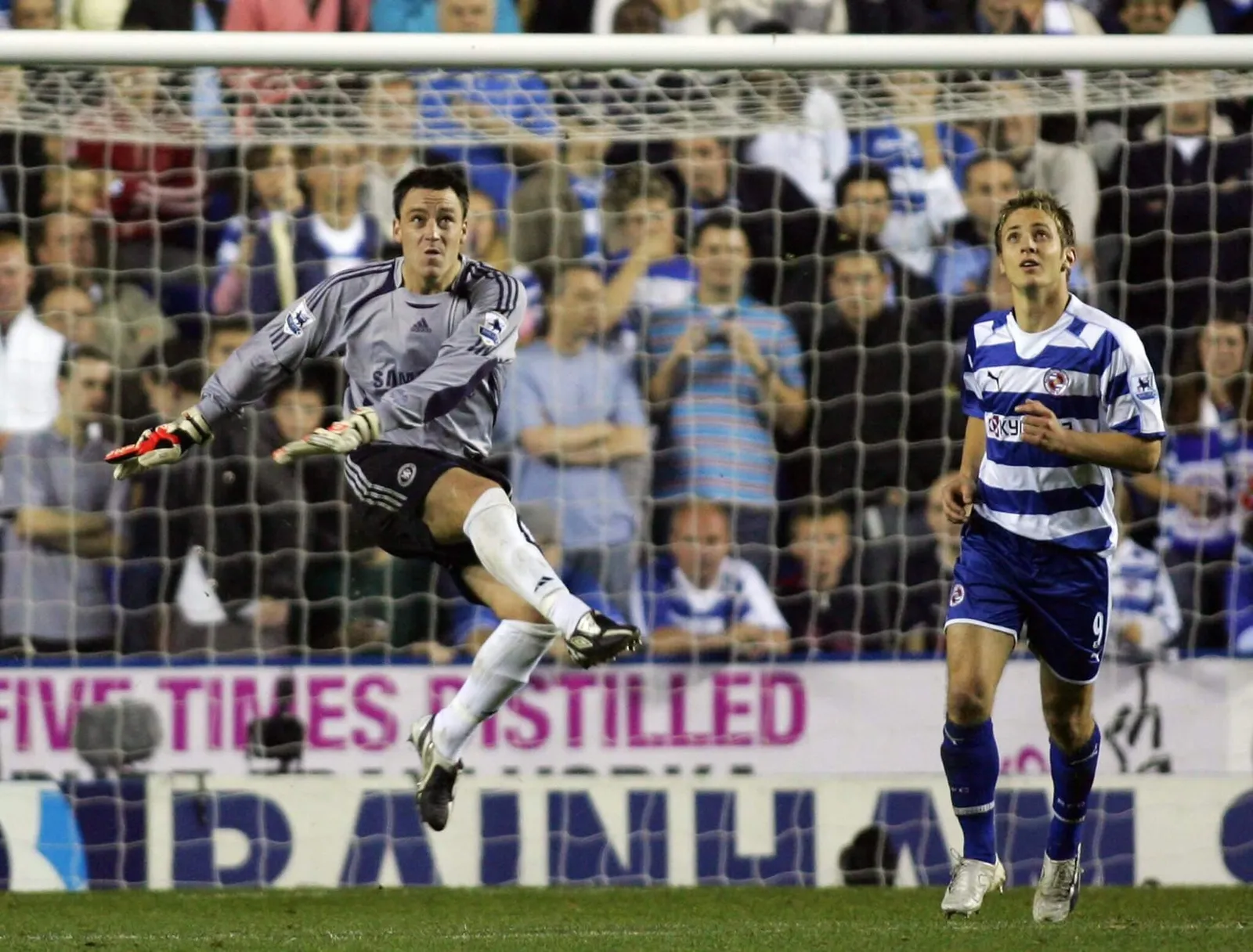
Terry thumps a kick up the pitch during his spell in goal against ReadingADRIAN DENNIS/AFP via Getty Images
“It was always going to be me,” Terry said in an interview with FourFourTwo magazine in 2025. “Jose asked us early on in his Chelsea days, ‘If anything ever happens to both of my goalkeepers and we don’t have any subs, who will step up?’
“I told him I’d do it. That tells you so much about Jose because, from then on, I would go in goal at the end of training sessions, to prepare for that day if it ever came. I even had my own pair of gloves brought to every match by the kit man, just in case I needed them. Jose left nothing to chance.”
Terry restarted the game by booting the ball upfield, but was never required to make a save or catch. Drogba cleared Reading’s only attempted high ball into the box and Riley blew the final whistle.
Chelsea’s ordeal at the Madejski Stadium was over, but Cech’s was just beginning.
Cech emerged from emergency surgery with two metal plates in his skull, significant memory loss and the serious possibility that his football career might be over.
“Every time I woke up conscious, the doctor kept asking me the same set of questions, which I kept forgetting the answers to,” he wrote in a column for Chelsea’s website in 2021. “I would fall asleep again, wake up a couple of hours later, and couldn’t remember anything again.
“Nobody knew if I would be able to come back. There were plenty of questions, and not many answers. In my head, I had to prepare for the end of my career. That made me see things in a different way.”
During the heat of Chelsea’s battle against Reading, Cech’s team-mates were spared the frightening reality of their goalkeeper’s situation. “The club tried to protect us from the bad news they already heard about Petr — that he had to have surgery, it would be a long recovery and what was going to happen,” Ricardo Carvalho tells The Athletic.
“They tried to protect us in the first moments, even at the end of the game. It was the next day that I got to realise how serious it was.”
The squad visited Cech in hospital several days later. He pinpoints that as the moment when his memory began to return, and Carvalho believes it was a big moment for the Chelsea squad too.
“He was talking and his face looked fine,” he recalls of seeing Cech. “He was positive, happy. He was smiling, wanted to see people and talk. I think it was important for him to feel the group was completely with him.
“He was so important to us. We had been together as a group for a long time and were a family. It felt like a member of our family was suffering a lot. I think it was the worst thing I experienced in my six years at the club, when you see a team-mate suffering an injury like Petr had.”
Chelsea overcame Bayern Munich in Munich in 2012 to win their first Champions League trophy
With the growing realisation came the fury, led in public by Mourinho. While accepting that Sonko’s collision with Cudicini had been accidental, he described Hunt’s challenge on Cech as a “disgrace” and called upon the Football Association to take action, claiming that the Irishman had laughed about the incident afterwards — an accusation echoed by Drogba to L’Equipe.
Mourinho also directed his ire at the emergency services, alleging that Cech had been waiting for an ambulance in the Chelsea dressing room for 30 minutes. “If my goalkeeper dies in that dressing room, or in that process, it is something English football has to think about,” he said. South Central Ambulance Service strongly disputed Mourinho’s version of events, insisting that the response time had been just seven minutes.
Hunt ultimately faced no action from the FA, but Mourinho’s assertion that he had acted deliberately further raised the temperature. He and Sonko received written death threats at Reading’s training ground. The players pinned the first one up on the dressing room door to make light of the situation, but Thames Valley Police were called in to investigate when subsequent letters arrived.
“To imply that Stephen meant to do it, I don’t think that it was right,” Sonko tells The Athletic. “We know that Jose is a character, and I think at the time he was really upset and really annoyed about the situation with his goalkeeper, and he wanted the punishment to fall on Stephen.
“Stephen is an excited person in that he always gives his all. He runs so hard, that was his trademark, really. A game like Chelsea was an exciting game to play for all of us, we finally reached where we wanted to be — playing against Lampard, Drogba and Terry was a moment that we knew we had to cherish.
“So you can understand why he was overexcited. This wasn’t something out of nastiness. He didn’t want to hurt Cech. Stephen was just being Stephen, and unfortunately it came at a cost and Cech got injured. Hunty was distraught after the game, he was really sorry about the incident.
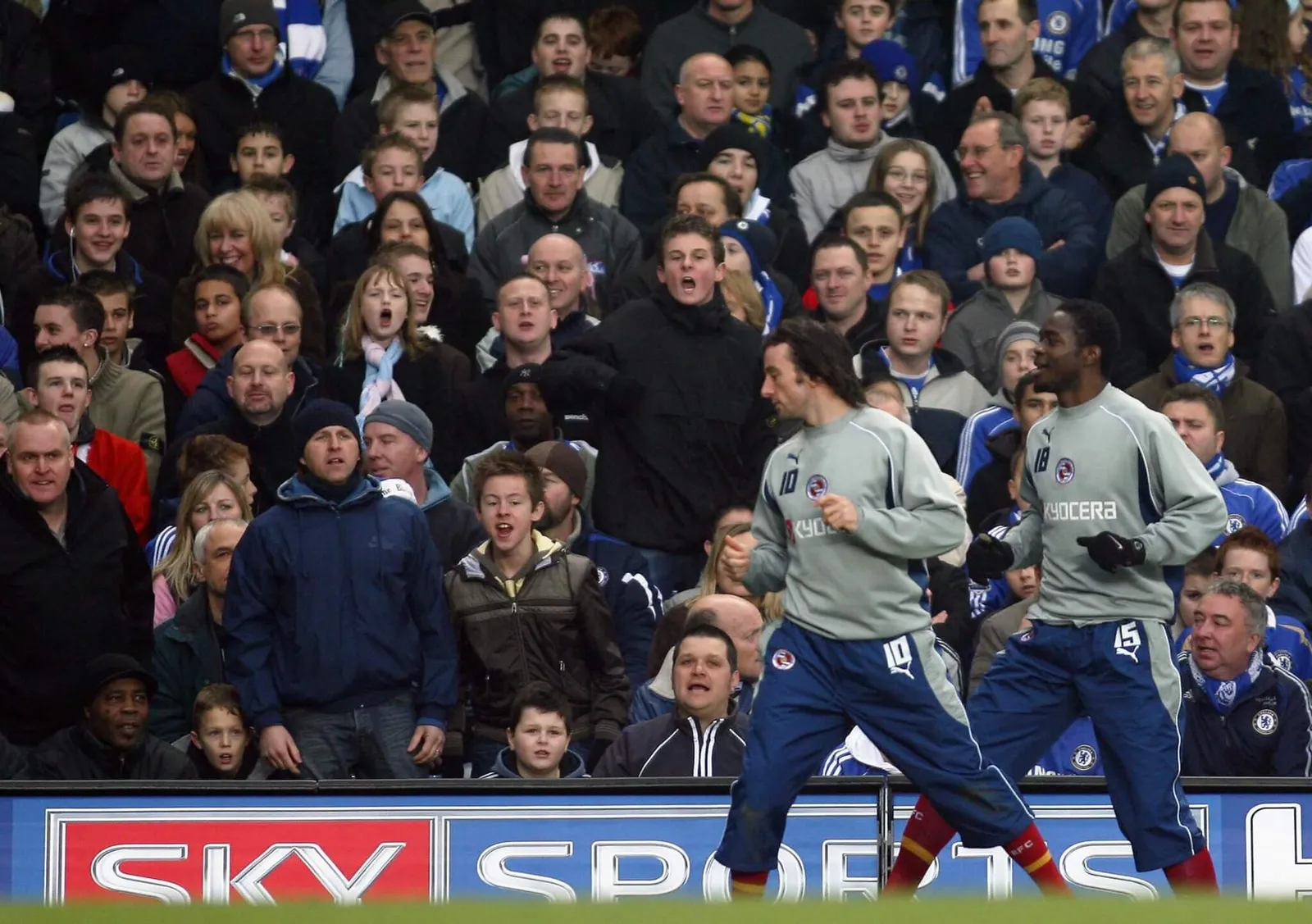
When the two teams met in the return Premier League fixture at Stamford Bridge in December, Reading manager Steve Coppell left Hunt on the substitutes’ bench in a bid to protect him. Sonko played and was booed every time he touched the ball, but any attempts at intimidation fell flat as Chelsea were held to a 2-2 draw.
ADRIAN DENNIS/AFP via Getty Images
By then, Cech had thrown himself into his recovery programme at Cobham. Doctors informed him that his skull required 12 weeks to heal, meaning he could only train alone for the first three months with no risk of further contact to his head.
“In those situations, you have two options: you look at everything as a problem or everything as a challenge,” Cech said during an appearance on the High Performance podcast in 2024. “I don’t see it as a problem, I always see it as a challenge. The doctors told me, ‘Listen, forget the season. You don’t play. We’ll see how everything goes. If you can come back, you come back. If you can’t come back, you do something else. Let’s forget the season, we go day by day.’
“When you have a knee surgery, you know pretty much how it goes. With the brain, it’s completely different. I had days where I couldn’t do anything. I woke up in the morning and I couldn’t get out of bed. Every slight bit of noise, every movement, every activity just killed me. But then there were days when I could do what we planned for the day plus the next two days.”
Cech started noting down his good and bad days in order to help himself see the bigger picture of his recovery progress. He always pushed himself to his physical limits, but he learned to recognise the point at which his body had no more to give: when his eyes began to twitch, he knew he had around five minutes to stop before he passed out.
In the first month after surgery, he limited himself to basic physical exercises. In the second, he began to train on his own. In the third month he started playing tennis, running and working in the gym and the pool at Cobham.
“He was in there every day,” Carvalho says of Cech. “He is the kind of guy that, when he puts it in his mind to do something, he will do it. So even though there was a long way to recovery, he worked to recover completely. He would spend hours every day doing his rehab. He is very strong mentally.”
Ten years after he suffered a cardiac arrest on the pitch at White Hart Lane, Fabrice Muamba is reunited with the doctors who saved his life
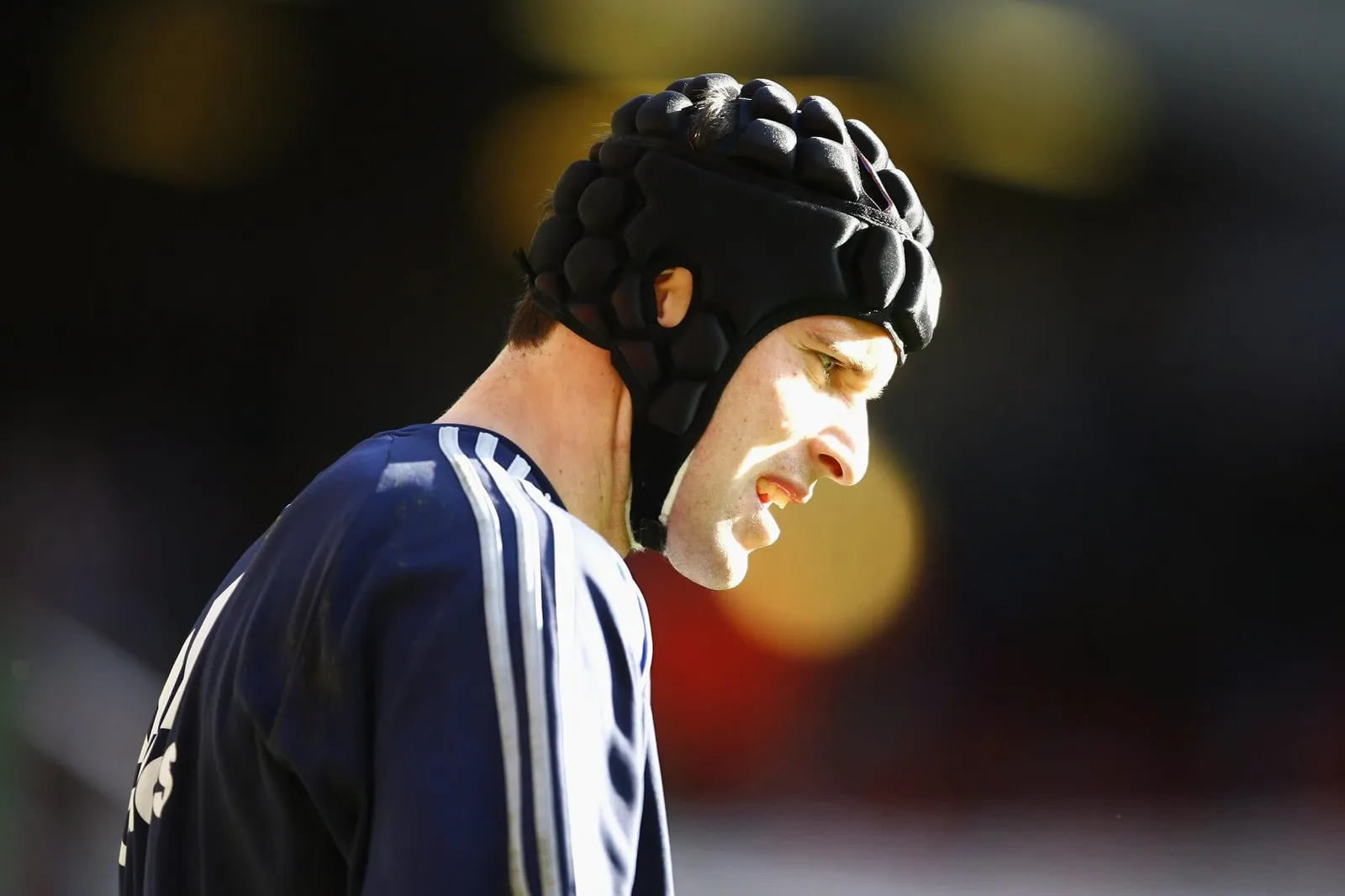
Cech’s head had to be protected throughout his recovery process. At first, he was equipped with a rugby skull cap made by New Zealand sports manufacturer Canterbury, who then designed and supplied several bespoke prototypes until a suitable model was found that provided enough protection to the affected area.
By the time 12 weeks had passed, Cech felt in such good physical condition that he returned to Chelsea first-team training as soon as he received medical confirmation that his skull had fully healed. After just two sessions with the squad, Mourinho asked him if he felt ready to play.
Cech returned to action against Liverpool at Anfield on January 20, 2007, sporting the headguard that would become an iconic look. It was just 107 days after his surgery, but he had no fear of diving in at the feet of opponents.
Clive Mason/Getty Images
“The incident itself I don’t recall, and I think that was the biggest advantage for me coming back to the pitch,” he admitted. “I could see it on the video, but when I came back, it never crossed my mind.”
Chelsea lost 2-0 to Liverpool, but Cech then kept six clean sheets in a row across all competitions. He was voted Premier League Player of the Month for March 2007 and ended the season with an FA Cup winner’s medal after keeping Manchester United at bay at Wembley.
The headguard required him to be a little more proactive in scanning for opponents behind him at set pieces, but it imposed no technical or physical limitations on his goalkeeping. It simply allowed him to regain his world-class form with full physical commitment, without worrying about the risk of another head injury.
Cech went on to win six more major trophies as Chelsea’s starting goalkeeper, culminating in his penalty-saving heroics against Bayern Munich in the 2012 Champions League final. Those triumphs were even more meaningful in the context of what he had endured, but the legacy of that fateful day at the Madejski Stadium went beyond the arc of his own career.
In the wake of Cech’s injury, Premier League regulations were tightened to require every club to have a doctor in the dugout and two paramedics on the sidelines, with an ambulance on standby at the stadium. These changes helped save the life of Bolton Wanderers midfielder Fabrice Muamba when he went into cardiac arrest during a game at White Hart Lane in 2012, as well as ensuring swift treatment for numerous supporters who have suffered medical emergencies in the stands in recent years.
“You need something bad to make a good change sometimes,” Cech later said of his Reading experience. “That changed the rule and made everybody safer, so in a way it was a good thing.”
Tags
More in Premier League
View all ›14 Oct 2026
Premier LeagueRyan Gravenberch is a hugely talented player. How can Andoni Iraola eke out more from him?
14 Oct 2026
Premier LeagueLeny Yoro’s France debut underlined his potential. Man United must find a way to see more of it
12 Oct 2026
Premier LeaguePeter Schmeichel Urges Premier League to Keep Man City as He Proposes Four Severe Punishments
About the author

Collins Godfrey
Writer